Agentic Data Engineering Harness

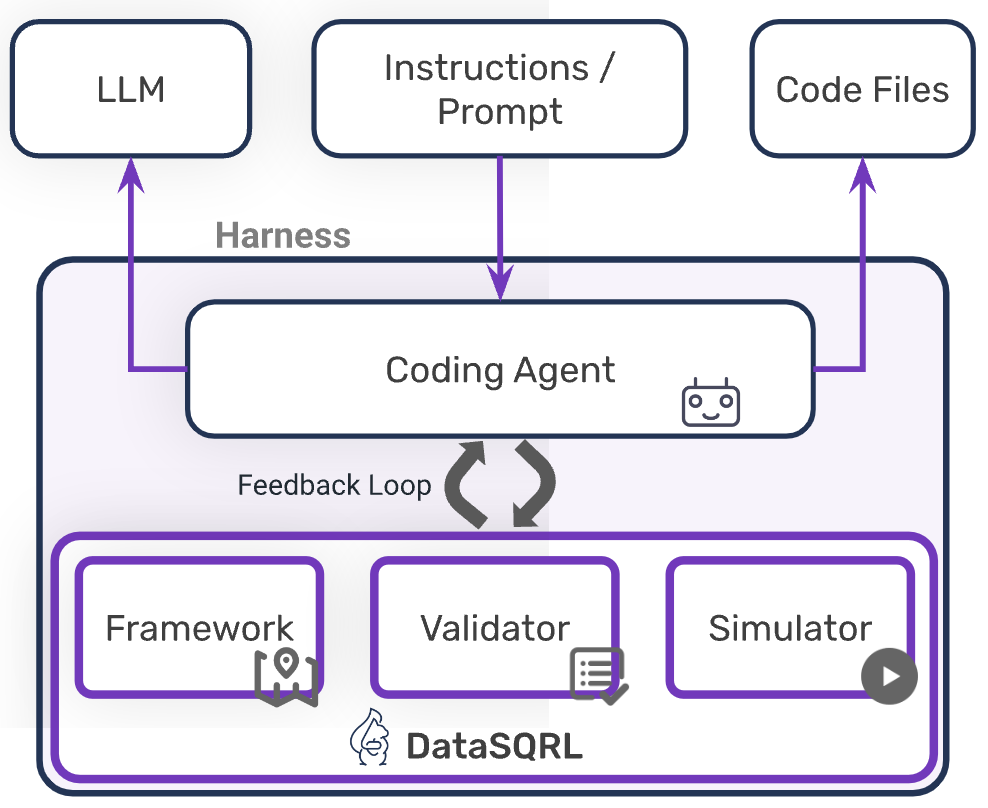
DataSQRL is an open-source data engineering harness that provides guardrails and feedback for AI coding agents to develop and operate data pipelines, data products, and data APIs autonomously. You can customize DataSQRL as the foundation of your agentic data platform. Our goal is to develop DataSQRL into a comprehensive data engineering harness for data platform automation.
Why a Data Engineering Harness?
Coding agents are transforming software development. Tools like Claude Code, Copilot, and Codex can generate application code, write tests, and even refactor entire codebases. But data engineering presents unique challenges that general-purpose coding agents struggle to address.
The difference lies in non-functional requirements. When you build a data pipeline, functional correctness (does the query return the right results?) is just the starting point. Production data systems must also deliver:
- Data Quality: Consistent, accurate data with proper handling of late-arriving events, duplicates, and schema evolution
- Scalability: Performance that holds up as data volumes grow from gigabytes to terabytes
- Governance: Lineage tracking, access controls, and audit trails for regulatory compliance
- Reliability: Exactly-once semantics, failure recovery, and graceful degradation under load
- Cost Efficiency: Optimal resource utilization across compute, storage, and network
A coding agent can generate a SQL query that produces correct results on a test dataset. But will that query perform at scale? Does it handle late data correctly? Will it maintain data quality guarantees when upstream schemas change? These are the questions that justify data engineering as its own discipline and that general-purpose coding agents are not equipped to answer consistently.
A data engineering harness provides the guardrails, feedback loops, and domain-specific constraints that coding agents need to produce production-grade data systems. Without a harness, you get code that works in demos but fails in production. With a harness, you get data pipelines that embody decades of hard-won data engineering and domain-specific knowledge.
DataSQRL is that harness. It encodes the conceptual framework of data systems, validates implementations against data engineering best practices, and provides real-world feedback through simulation and production telemetry. The goal is to constrain coding agents into building data systems you'd actually trust to run in production.
The DataSQRL Harness
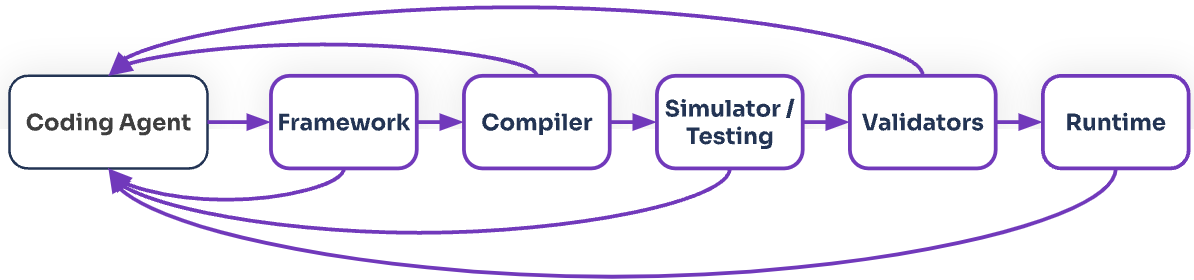
For the purposes of automating data platforms, a comprehensive harness captures data schemas, data processing, and data serving to consumers. Specifically, we are building a harness for non-transactional data processing and serving.
The harness provides the frame of reference for implementing safe, reliable data processing systems. It captures the knowledge from Database Systems: The Complete Book combined with 25 years of data engineering experience.
DataSQRL breaks the harness into logical and physical layers.
Logical Layer
The logical layer expresses what data transformations are needed to produce the desired results.
An obvious choice for the logical layer is Codd's relational model and its most popular implementation SQL.
The relational model is widely adopted, proven, and provides a solid mathematical foundation. Most LLMs are trained on lots of SQL code and related documentation. And it is easy for humans to read. Modern versions of SQL (e.g., the SQL:2023 standard) support semi-structured data (JSON), polymorphic table functions, and complex pattern matching to address the messy reality of data platforms.
While the relational model and SQL are a good starting point, we need two additions to achieve the expressibility that modern data platforms require.
1. Dataflow
The relational model uses set semantics. That is inconvenient for representing data flows which are important for data pipelines.
Jennifer Widom's Continuous Query Language extends the relational model with data streams and relational operators for moving between streams and sets.
Flink SQL, based on Apache Calcite, is the most widely adopted implementation of this extended relational model. That's why we use Flink SQL as the basis of the logical layer in DataSQRL.
Using a declarative language for the harness has a number of advantages from concise representation to deep introspection, but a practical shortcoming is the fact that some data transformations are easier to express imperatively. Flink SQL overcomes this by supporting user defined functions and custom table operators in programming languages like Java. This gives us a logical layer grounded in relational algebra with flexible extensibility to express complex data transformations imperatively.
DataSQRL builds on Flink SQL and adds 1) concise syntax for common transformations, 2) dbt-style templating, and 3) modular file management and importing. These features help with context management for LLMs by reducing the size of the active context that needs to be maintained during implementation and refinement.
-- Ingest data from connected systems
IMPORT banking_data.AccountHoldersCDC; -- CDC stream from masterdata
IMPORT banking_data.AccountsCDC;       -- CDC stream from database
IMPORT banking_data.Transactions;      -- Kafka topic for transactions

-- Convert the CDC stream of updates to the most recent version
Accounts       := DISTINCT AccountsCDC ON account_id ORDER BY update_time DESC;
AccountHolders := DISTINCT AccountHoldersCDC ON holder_id ORDER BY update_time DESC;

-- Enrich debit transactions with creditor information using time-consistent join
SpendingTransactions :=
SELECT
    t.*,
    h.name AS creditor_name,
    h.type AS creditor_type
FROM Transactions t
         JOIN Accounts FOR SYSTEM_TIME AS OF t.tx_time a
           ON t.credit_account_id = a.account_id
         JOIN AccountHolders FOR SYSTEM_TIME AS OF t.tx_time h
           ON a.holder_id = h.holder_id;
We call this SQL dialect SQRL. You can read the documentation for a complete reference of the SQRL language.
2. Serving
In addition to data processing, a critical function of data platforms is serving data to consumers as data streams, datasets, or data APIs. Data APIs, in particular, are becoming more important with the rise of operational analytics and MCP (Model Context Protocol) for making data accessible to AI agents.
To support data serving, DataSQRL adds support for endpoint definitions via table functions and explicit relationships.
Table functions are part of the SQL:2016 standard and return entire tables as result sets computed dynamically based on provided parameters. In DataSQRL, table functions can be defined as API entry points.
/** Retrieve spending transactions within the given time-range.
  from_time (inclusive) and to_time (exclusive) must be RFC-3339 compliant date time.
*/
SpendingTransactionsByTime(
  account_id STRING NOT NULL METADATA FROM 'auth.accountId',
  from_time TIMESTAMP NOT NULL,
  to_time TIMESTAMP NOT NULL
) :=
SELECT * FROM SpendingTransactions
WHERE debit_account_id = :account_id
  AND :from_time <= tx_time
  AND :to_time > tx_time
ORDER BY tx_time DESC;
Furthermore, DataSQRL allows for explicit relationship definitions between tables which are important for API-based data access where results need to include related entities like most recent orders or recommendations for movie category. The relational model does not support traversing through an entity-relationship model, which is usually handled by an object-relational mapping layer when exposing an API. To avoid that extra complexity and impedance mismatch in our logical layer, DataSQRL provides first-class support for relationships.
-- Create a relationship between holder and accounts filtered by status
AccountHolders.accounts(status STRING) :=
SELECT * FROM Accounts a
WHERE a.holder_id = this.holder_id
  AND a.status = :status
ORDER BY a.account_type ASC;
With the addition of access functions and relationships, the logical layer maps directly to the entity-relationship model of GraphQL which DataSQRL uses as the logical representation for API-based data retrieval. This gives DataSQRL a highly expressive interface with a simple extension of the logical layer which retains conceptual simplicity of the harness.
The interface documentation provides more details on the serving layer of DataSQRL.
Physical Layer
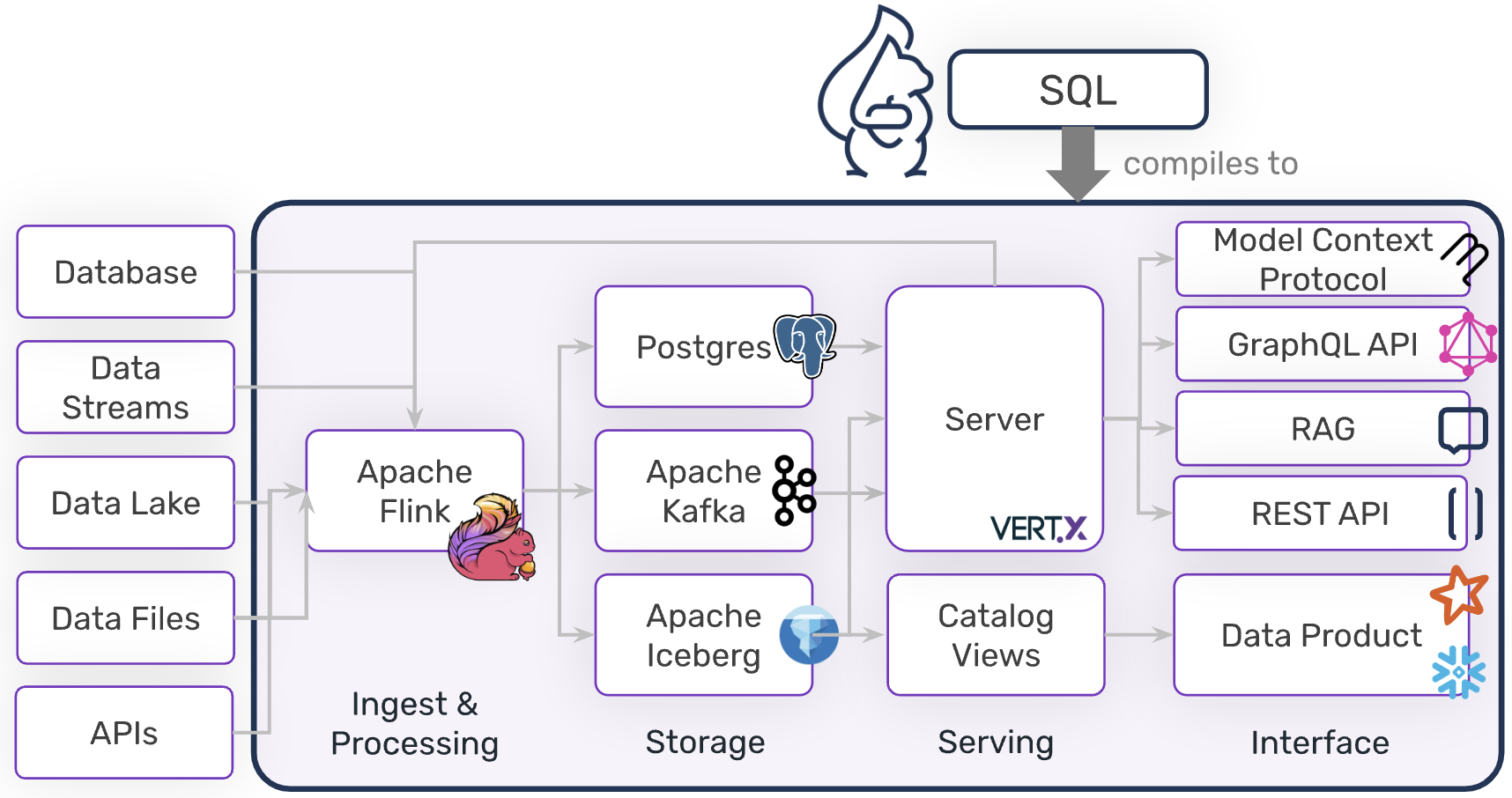
The physical layer represents how the data gets processed and served. It's a translation of the logical layer into executable code that runs on actual data systems.
Pipeline Architecture
With hundreds of database systems and many more data infrastructure choices, it is a daunting challenge to construct a simple and coherent physical layer that is flexible enough to cover the diverse needs of data platforms.
After analyzing a wide range of data platforms, we identified that the vast majority of implementations combine multiple data systems from these categories:
- Database: for storing and querying data, e.g., PostgreSQL, MySQL, SQLServer, Apache Cassandra, Clickhouse, etc.
- Table Formats and Query Engines: For analytic data, separating compute from storage can save money and support multiple consumers. DataSQRL conceptualizes this as a "disintegrated database" with table formats for storage (e.g., Apache Iceberg, DeltaLake, Apache Hudi) and query engines for access (e.g., Apache Spark, Apache Flink, Snowflake).
- Data Processor: for batch or realtime transformation of data, e.g., Apache Spark, Apache Flink, etc.
- Log/Queue: for reliably capturing data and moving it between data systems, e.g., Apache Kafka, RedPanda, Kinesis, etc.
- Server: for capturing and exposing data through an API
- Cache: sits between server and database to speed up frequent queries over less-frequently changing data.
We call each data system an engine and the above categories engine types. When looking at data platform implementations at the level of engine types, we see about 15 patterns emerge (the 10 most popular are documented here) that arrange those engines in a directed-acyclic graph (DAG) of data processing.
Hence, we use a computational DAG that models the flow of data from source to interface as the basis of our physical layer. Each node in the DAG represents a logical computation mapped to be executed by an engine. Thus, the physical layer provides an integrated view of the entire data flow.
Transpiler
While the physical layer gives the AI control over what engine executes which computation, the actual mapping of logical to physical plan is done by a deterministic transpiler built in Apache Calcite. This avoids subtle bugs in data mapping and execution. The results of the transpilation are deployment assets which are executed by each engine. For example, the transpiler generates the database schema and queries for Postgres.
In the transpiler component, we make the following simplifying assumptions:
- The database engines support a version of SQL (e.g., PostgreSQL, T-SQL) or a subset thereof (e.g., Cassandra Query Language)
- The data processor supports a SQL-based dialect (e.g., Spark SQL, Flink SQL)
- The log engine is Apache Kafka compatible (e.g., RedPanda, Azure EventHub)
- The server has a GraphQL execution engine.
This modular architecture allows new engines to be added by conforming to the engine type interface and implementing the transpiler rules in Calcite where needed. At the same time, it abstracts much of the physical plan mapping complexity from the AI, which produces higher quality results and preserves context for higher-level reasoning.
Configuration
DataSQRL uses a package.json file to configure the engines used to execute a data pipeline. The configuration file defines the overall pipeline topology, the individual engine configurations, and the compiler configuration. One file controls how the physical layer is derived and executed, making it simple for the AI to experiment with and fine-tune the physical layer.
Interface
For the data serving interface, we use GraphQL schema as the physical representation which bidirectionally maps to the access functions, table schema, and relationships defined in the logical plan by naming convention. GraphQL fields are mapped to SQL or Kafka queries based on their respective definitions in SQRL. This allows the AI to fine-tune the API within the GraphQL schema.
Furthermore, REST and MCP APIs can be explicitly or implicitly defined through GraphQL operations. Implicit definition traverses the GraphQL schema from root query and mutation fields. Explicitly defined operations are provided as separate GraphQL files.
Using GraphQL as the physical representation for the API combines simplicity with flexibility while benefiting from the prevalence of GraphQL in LLM training data.
Validator
The harness gives AI coding agents a frame of reference to reason about data pipeline and data product implementations. DataSQRL provides validation to support that reasoning and give users tools to ensure the correctness and quality of the generated pipelines and APIs.
Verification & Introspection
Verification and introspection complement the harness by reinforcing the concepts, rules, and dependencies. DataSQRL provides validation at 3 levels: the logical layer, physical layer, and deployment assets (the code that gets executed by the engines).
Logical
At the logical level, the DataSQRL compiler verifies syntax, schemas, and data flow semantics. This ensures that the data pipeline is logically coherent and that data integration points (e.g., between the SQL definitions and GraphQL schema) are consistent.
One of the benefits of using relational algebra as the basis for our harness is the ability to run rules and deep traversals over the operators in the relational algebra tree. The DataSQRL compiler uses Apache Calcite's rule and RelNode traversal framework to validate timestamp propagation, infer primary keys and data types, validate table types, and more. This validation component can be extended with custom rules to validate domain-specific semantics and constraints.
The validation component was designed to provide comprehensive context and suggested fixes for validation errors. In our testing, this produces significantly better results compared to the AI coding agent having to look up and reason about encountered errors.
Physical
On compilation, DataSQRL produces the computational data flow DAG that represents the physical layer. DataSQRL generates a visual representation as shown above for human validation as well as a concise textual representation that is consumed by coding agents as feedback on their proposed solutions and to reinforce the conceptual data flow of the harness.
=== CustomerTransaction
ID:     default_catalog.default_database.CustomerTransaction
Type:   stream
Stage:  flink
Inputs: default_catalog.default_database._CardAssignment, default_catalog.default_database._Merchant, default_catalog.sources.Transaction
Annotations:
 - stream-root: Transaction
Primary Key: transactionId, time
Timestamp  : time
Schema:
 - transactionId: BIGINT NOT NULL
 - cardNo: VARCHAR(2147483647) CHARACTER SET "UTF-16LE" NOT NULL
 - time: TIMESTAMP_LTZ(3) *ROWTIME* NOT NULL
 - amount: DOUBLE NOT NULL
 - merchantName: VARCHAR(2147483647) CHARACTER SET "UTF-16LE" NOT NULL
 - category: VARCHAR(2147483647) CHARACTER SET "UTF-16LE" NOT NULL
 - customerId: BIGINT NOT NULL
This representation of the physical layer combines the inferences from the logical layer with the mapping to execution engines to provide a source-to-interface definition of the data flow.
Validation at the physical level ensures that data type mappings are consistent and that the engine assignments are valid, i.e., that an assigned engine has the capabilities to execute a particular operator. DataSQRL uses a capabilities component that extracts all requirements from an operator (e.g., temporal join, or a particular function execution) and validates that the engine supports the corresponding capabilities.
Deployment Assets
The executable deployment assets are transpiled from the physical layer. Since the transpilation is deterministic, this yields better results than letting the coding agent generate them, and it keeps the harness concise. However, we generate all deployment assets in a text representation that the coding agent can easily consume as another source of feedback. This is particularly useful during troubleshooting where the deployment assets are the ultimate source of truth of what is being executed and allow the agent to reason "backwards" to the logical layer and how to fix it.
Specifically, we generate:
- Database: The database schema, index structures, and (parameterized) SQL queries for all views and API entrypoints.
- Data Processor: The optimized physical plan and compiled execution plan.
- Log: The topic definitions and filter predicates.
- Server: The mapping from GraphQL fields to database or Kafka queries as well as operation definitions. Also, the GraphQL schema if it is not provided.
Optimization
While LLMs' reasoning ability under uncertainty is outstanding, we have found LLMs to perform worse and less consistently on deterministic optimization and constraint satisfaction problems. This finding is supported by a rich body of research in neuro-symbolic AI which researches the integration of neural networks (like LLMs) with symbolic computation (e.g., solvers, planners) and has documented how neural networks alone fall short for such tasks.
DataSQRL follows the neuro-symbolic approach and provides 3 types of planners for deterministic sub-tasks in the implementation and maintenance of data pipelines:
Query Optimization
Query rewriting and optimization is a well-established technique for producing high-performing physical plans from relational algebra. DataSQRL relies on Apache Calcite's Volcano optimizer and HEP rule engine for this purpose.
Physical Planning
The physical plan DAG is subject to a number of constraints forced by the real-world constraints of physical data movement. For example, when the API needs to serve data on request, that data must first be available in the database. It cannot be served directly from a data processor. These topological constraints combined with the capabilities of individual engines render many AI-proposed solutions invalid.
Hence, we implement a physical planner that uses a cost model with a greedy heuristic to assign logical operators to engines in a way that is consistent. The AI can provide hints to force the assignment of certain operators to specific engines which are added as constraints to the optimizer. This gives the AI control over allocations but shifts the burden of constraint satisfaction to a dedicated solver.
Index Selection
Efficiently querying data in the database or table format requires index structures (or partition + sort keys) that support the access paths to the data. Otherwise, we execute inefficient table scans.
Index structure selection is another optimization problem that is better handled by a dedicated optimizer. We use an adaptation of Ullman et al's lattice framework for data cube selection since data cube selection and index selection are related problems with different optimization functions.
Real World Feedback
A harness with complementary verification and introspection provides the foundation of a concise model for data pipelines with feedback on proposed solutions. However, that feedback is limited to the plan and does not account for the complexities of actual execution. Real-world feedback is critical for iterative refinement of production-grade implementations and troubleshooting issues that arise in operation.
DataSQRL provides two sources of real-world feedback: a simulator that's used at implementation time and telemetry collection from production deployments that captures the operational status of the pipeline.
Simulator
The DataSQRL simulator executes the configured engines with the generated deployment assets within a Docker environment. The simulator can replay events and records at their original timestamp, allowing for deterministic reproducibility of real-world scenarios. This is important for creating realistic test cases as well as reproducing production issues for troubleshooting and regression testing.
By capturing and faithfully replaying records at their original timestamp, the simulator ensures time-consistent semantics of data flows and makes it simple to construct complex test cases for scenarios like race conditions.
Simulation is important in agentic coding workflows because it allows the agent to execute and refine the implementation in a feedback loop that is executed locally and can simulate scenarios that only occur rarely in production.
Read more about invoking the simulator and writing reproducible test cases.
Operations and Telemetry
The most important source of real-world feedback is observing the deployed data pipeline in a production environment (or a closely approximated pre-prod environment). Observability is critical for assessing the health of the pipeline and troubleshooting any issues that may occur.
Logs and telemetry collection is a well-established practice for DevOps. What DataSQRL adds is the ability to link observed data back to the physical computation DAG so the agent can accurately reason about cause and effect. For data pipelines that execute across multiple engines, many complex errors arise at system boundaries and require reasoning across multiple systems. For example, an issue in the data processing layer may cause excessive writes to the database, degrading overall performance. To automate such troubleshooting, we need to correlate observations back to the physical data flow and logical layer.
DataSQRL currently assumes production operation in Kubernetes or Docker and provides hooks for extracting logs and telemetry data. That data is correlated back to the SQL code and configuration defining the pipeline via the deployment assets, allowing coding agents to reason about effective solutions for troubleshooting production issues autonomously.
Summary
Data engineering is entering a new era of automation. Coding agents can now write SQL, configure pipelines, and deploy data systems. But without proper guardrails, they produce solutions that fail under the weight of production requirements.
DataSQRL is the data engineering harness that ensures AI coding agents produce high-quality pipelines. DataSQRL encodes decades of data engineering knowledge into a structured framework that coding agents can leverage to build production-grade data systems.
The harness provides three critical capabilities:
-
A Conceptual Framework grounded in relational algebra and stream processing that gives agents a precise vocabulary for reasoning about data transformations, with logical and physical layers that separate what from how.
-
Comprehensive Validation at every level ensures that agent-generated code meets data engineering standards before it reaches production: from syntax and schema validation through physical plan verification to deployment asset generation.
-
Real-World Feedback Loops through simulation and production telemetry that enable agents to iteratively refine implementations based on actual execution behavior, not just static analysis.
For any organization pursuing data platform automation, a data engineering harness is foundational to avoid shipping data pipelines that fail in production. Without it, you're asking general-purpose coding agents to navigate the complex constraints of distributed data systems without a map. With DataSQRL, you're equipping them with the domain expertise and multiple sources of feedback to succeed.
DataSQRL is open-source so you can customize it to build a self-driving data platform tailored to your organization.
Getting Started
To try out DataSQRL:
- Build a project from scratch with DataSQRL to see how the components of DataSQRL work
- Explore the AI generated data products for a fictional bank based on the bank's catalog definition as an example.
- Read the documentation
- Check out the open-source project on GitHub